
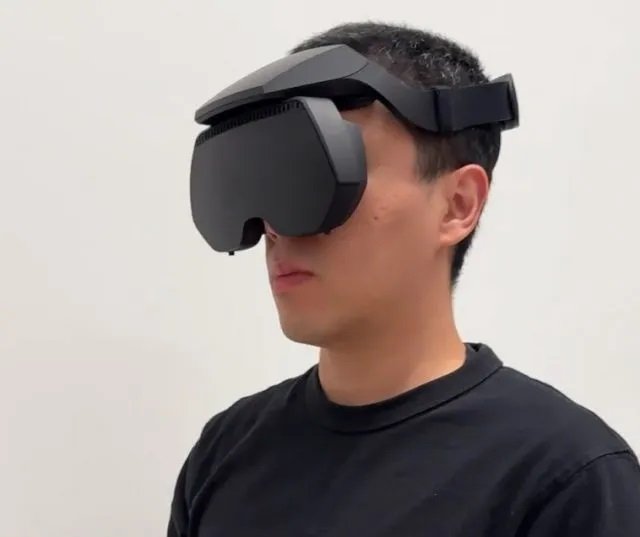
Ahead of the upcoming ACM SIGGRAPH 2025 Emerging Technologies conference, researchers from Meta’s Reality Labs Research have shared details of their latest breakthrough in VR and MR headset design—achieving an ultra-wide 180° horizontal field of view while maintaining a compact, goggles-style form factor.
The research introduces two experimental headsets:
- One is a dedicated VR headset that utilizes high-curvature reflective polarizers to significantly expand the field of view without adding bulk.
- The second is an MR headset built on the same optical and structural foundation, but enhanced with four passthrough cameras. These cameras deliver a combined 80MP resolution at 60 FPS, enabling an ultra-wide passthrough view that matches the headset’s expansive FoV.
For comparison, Meta’s current consumer headset, the Quest 3, offers a field of view of around 100°—nearly half that of the experimental models.
In practical terms, the wider field of view on the MR prototype allows for more natural situational awareness. For example, users can see someone sitting beside them or notice an object—like a snack—in their lap without needing to turn their heads, enhancing immersion and interaction.
The research highlights Meta’s continued push to evolve headset design by balancing wide visual range, clarity, and comfort, all while keeping the hardware compact and wearable.