
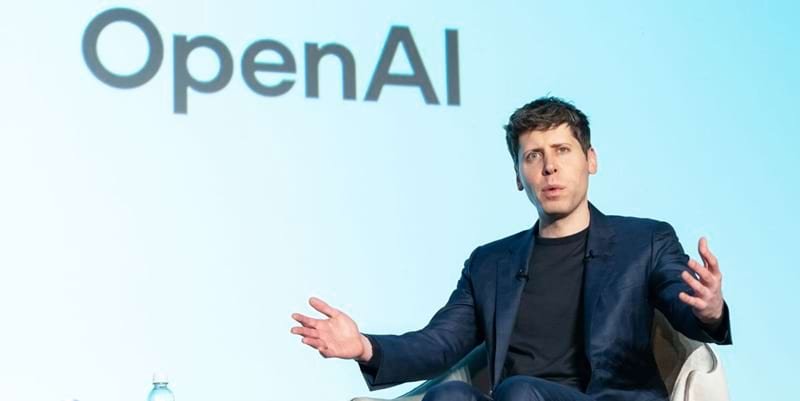
Two of Silicon Valley’s most prominent voices spent the better part of last year sounding alarms about artificial intelligence decimating white-collar work. Now, they’re walking those warnings back.
OpenAI CEO Sam Altman and Anthropic CEO Dario Amodei — both of whom made headline-grabbing predictions about AI wiping out millions of office jobs — have reversed course, joining Goldman Sachs CEO David Solomon in pushing back against the narrative of an AI-driven employment apocalypse. The timing is notable: both OpenAI and Anthropic are reportedly eyeing initial public offerings this year, with each company carrying an estimated valuation of around $1 trillion.
Altman Admits He Got It Wrong
Speaking in an interview with Commonwealth Bank of Australia CEO Matt Comyn, Altman openly acknowledged that his earlier predictions hadn’t panned out.
“I’m delighted to be wrong about this,” he said, admitting he had expected far greater disruption to entry-level white-collar roles by now than has actually occurred — a sharp reversal from warnings he issued as recently as June 2025 about serious risks to those very positions.
Altman acknowledged he’d taken heat for stoking unnecessary fear. “People are like, ‘Oh you could have saved the world a lot of fear mongering and a lot of doom and gloom,'” he said, defending his earlier stance by explaining that he believed the risk was real enough to warrant public discussion — and adding that it still may materialize eventually.
His change of heart was partly shaped by a personal experiment. After attempting to delegate his Slack messages and email replies to AI, he found himself reverting to handling them manually.
“We really do care about our interactions with people,” he reflected. “This thing is not something that I can imagine myself outsourcing to an AI anytime soon. It really updated me to thinking that the jobs picture is likely to be very different than we thought.”
This marks a significant departure from comments he made roughly a year ago on his brother Jack’s podcast, Uncapped, where he said flatly: “A lot of jobs will go away…we have always been really good at figuring out new things to do…I’m not a believer that that ever runs out.”
Amodei Reframes Automation as a Multiplier, Not a Destroyer
Amodei’s shift has been equally striking. Having once claimed that AI could eliminate up to 50% of white-collar jobs, he offered a fundamentally different framing earlier this month — one that positions automation as a force that expands what workers do rather than replacing them outright.
“If you automate 90% of the job, then everyone does the 10% of the job,” he explained. “And the 10% kind of expands to be 100% of what people do and kind of 10-times their productivity.” The argument echoes predictions made by economists Alex Imas and Tyler Cowen, and draws on the concept known as Jevons paradox — named for 19th-century English economist William Stanley Jevons, who observed that greater efficiency in coal burning led not to less coal consumption, but to more, as lower costs drove higher demand.
Solomon Never Flinched — And Now Says History Proves Him Right
Unlike his counterparts, Goldman Sachs CEO David Solomon hasn’t needed to revise his position because he never subscribed to the doomsday view. He has consistently pushed back against AI job panic since at least late 2025, and in a recent New York Times op-ed, he doubled down on that stance by drawing on a century of American economic history.
Tracing a line from the electrification boom of the early 1900s through the digital revolution of the 1990s and into today’s AI era, Solomon argued that the U.S. has an unbroken track record of generating new employment in the wake of technological disruption. Despite massive sectoral shifts across that time, civilian employment in America has grown 145% since 1962. He pointed to Goldman Sachs research showing that data center construction alone has created 200,000 jobs since 2022.
“Do any of us feel like we have less to do these days despite the convenience of Excel, email or Zoom?” he asked pointedly.
His argument finds academic support in a 2018 study by Nobel laureate Daron Acemoglu, which found that AI’s displacement effects are typically offset by productivity-driven increases in labor demand.
What the Data Actually Shows
The picture painted by real-world data is more complicated. Tech-sector layoffs through May 2026 have already surpassed 115,000 — approaching the total of 124,000 recorded across all of 2025 — with companies including Meta, Amazon, and Snap explicitly citing AI as a factor behind workforce reductions.
At the same time, the Yale Budget Lab has found no meaningful shifts in occupational composition or unemployment duration among workers in roles highly exposed to AI since ChatGPT launched in late 2022, suggesting the feared structural disruption has yet to fully materialize.
Tech executives have not spoken with one voice on the issue. Microsoft AI CEO Mustafa Suleyman has predicted that AI could automate the majority of white-collar work within 18 months, while Nvidia CEO Jensen Huang has argued the opposite — that AI won’t reduce headcount but will instead create efficiency gains that benefit workers who embrace the technology.
The Emerging Consensus: Automation Fuels Demand
A growing number of business leaders and economists are converging on a view that AI could ultimately be a net positive for labor. Box CEO Aaron Levie, responding to Solomon’s op-ed on LinkedIn, said he is betting Solomon will be vindicated.
“If you looked at what work looked like a few decades ago and saw how much faster everything is or easier it is to produce today — even before AI — you’d certainly have been convinced there’d be no jobs left,” Levie wrote. “Yet the opposite has happened. Why?” His answer: automation doesn’t reduce demand for a given role. It makes delivering the same value cheaper, which drives more of it.
Apollo’s chief economist Torsten Slok has made a similar argument, pointing to professions like call center workers and radiologists — both considered highly vulnerable to AI automation — whose employment has held steady or even grown despite broader AI adoption.
“Lower cost per interaction does not mean fewer interactions,” Slok wrote in a recent blog post. “It means more customers served, more channels opened and more markets worth reaching. The technology that was supposed to shrink the industry is fueling its expansion.”
Whether the optimists or the pessimists ultimately prove correct remains an open question. But for now, two of the loudest voices warning of an AI jobs crisis have gone quiet — and are, by their own admission, glad to have been wrong.